
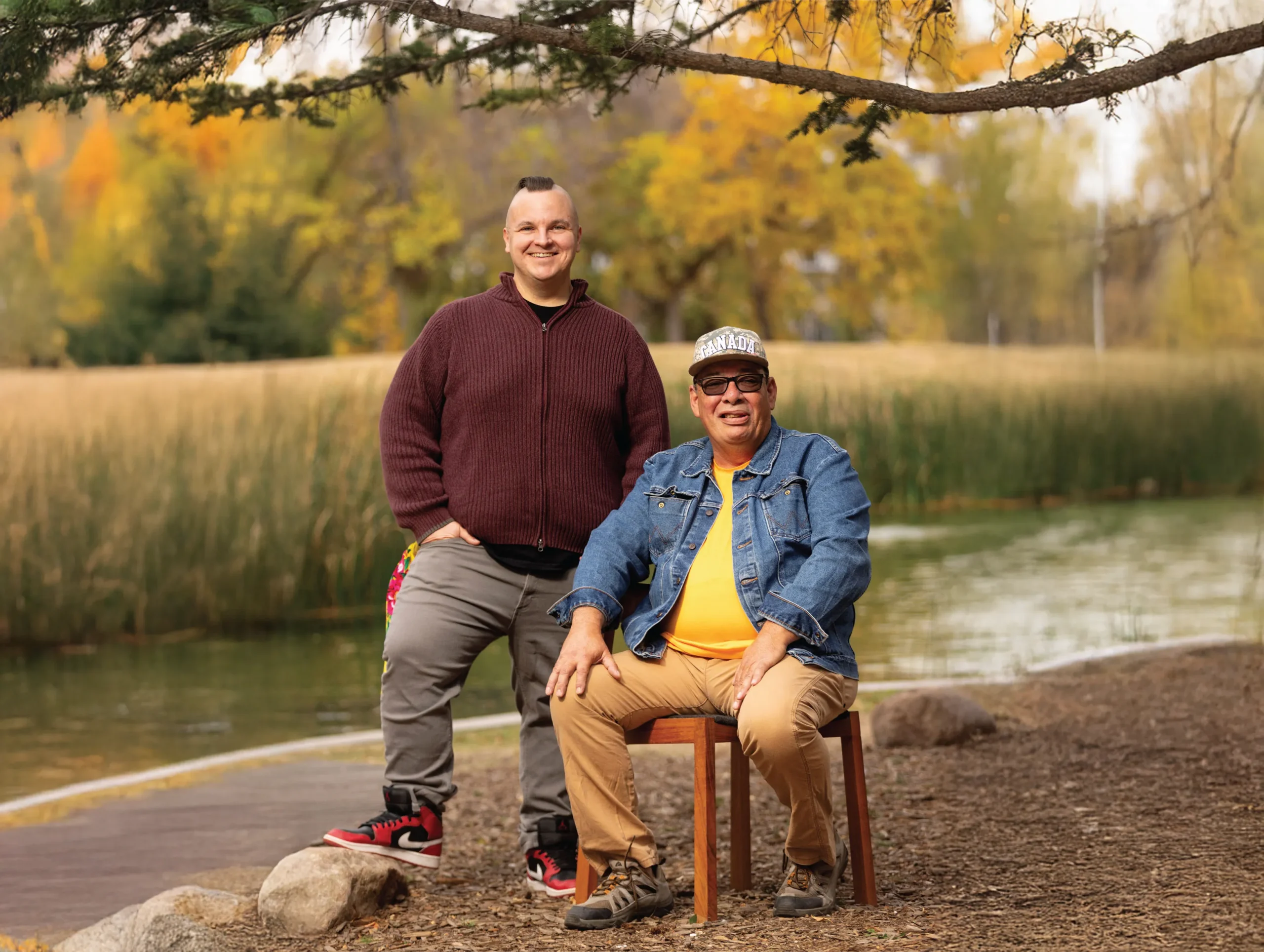
Storytelling isn’t just a way of sharing experiences. For many First Nations, Inuit and Métis communities, it’s how knowledge is passed down, relationships are built, and community is formed. Long before stories were written, they were spoken, shared, and carried forward through generations. “Our whole history is oral tradition,” says Blaine Paul, a member of Treaty 6 from Saddle Lake Cree Nation.
“We didn’t have a written language until the Jesuits came and then they came up with syllabics. So for us, being able to tell a story is how we transmit generational knowledge.”
Paul has spent much of his life working with stories, not just as memories of the past, but as tools for connection and healing today. As a co-facilitator of Bent Arrow Traditional Healing Society’s Building Bridges Through Storytelling program, he helps participants look at stories from their own lives in a new way. Alongside Matthew ‘Gus’ Gusul, a trained facilitator with a background in applied theatre and intercultural studies, Paul supports community members as they find their voice and learn how to share their experiences, insight and knowledge with others. “This Building Bridges project is about making good stories and making connections through stories,” says Gusul.
The program is supported by an $80,000 Community Grant from Edmonton Community Foundation (ECF) and brings together staff and community members connected to Bent Arrow, Boyle Street Community Services and Islamic Family Social Services Association (IslamicFamily). Over the course of the program, participants explore storytelling not just as performance, but as a way of understanding themselves and each other. “Stories play an integral role in building healthy communities,” says Cassandra Lundell, Manager, Grants at ECF. “We’re proud to support this initiative because it shows the power of collaboration. Bent Arrow, Boyle Street and IslamicFamily are coming together in a meaningful way to help people share their voices, strengthen relationships and build bridges across our community.”
For participants, the experience goes beyond learning the structure of a good story. At the start of the two-day workshop, they are welcomed with a smudging ceremony and opening prayer, grounding the experience in cultural practice and creating a space that is emotionally, spiritually and physically safe.“When we create that kind of safety in the space we’re working in, it’s an amazing thing,” says Paul.
“You see people from all different cultures there to support one another, and that’s not something you normally see in society.”
As the workshop unfolds, participants learn about Indigenous storytelling traditions and the deeper purpose behind them. In sharing their own stories and listening to others, many find unexpected points of connection. “There’s magic that happens,” Paul says. “It’s about people starting to come together and tearing down some of those walls they carry.” That openness often leads to healing. Participants leave with a stronger understanding of their own histories and a deeper sense of connection to the people around them. “There’s a lot of healing that happens inside these workshops,” says Paul.
Looking ahead, Gusul and Paul hope to grow the program further. Plans include developing a digital archive to preserve community stories for future generations and expanding the workshops to include participants of different ages, backgrounds and organizations. For Paul, the lasting impact is clear. “When we start to share these stories, you see those walls slowly chipping away,” he says. “And when they come down, we can really start to build community.”
This story comes from the Winter 2025 Edition of Thrive Magazine.
Read the full issue.
