
Stories Thrive Magazine / Stories / Community Stories / Blog
Birds of a Feather
The Beaverhill Bird Observatory and Edmonton Community Foundation flock together to safeguard Alberta’s birds for generations to come.

Picture a crisp fall evening east of Edmonton. The leaves have mostly dropped, and at the Beaverhill Bird Observatory (BBO), the last few nets of the season are being set.
Assistant Biologist John Van Arragon moves quietly through the dimming light, checking the fine nylon mesh strung between two poles. The net is nearly invisible unless you’re looking for it. “People walk into them all the time,” he says with a grin.
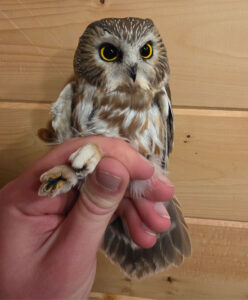
But people aren’t what Van Arragon and his team hope to catch. Tonight, they’re waiting for one last visitor before the season ends: a northern saw-whet owl. These tiny creatures are about the size of a pop can and are Canada’s most abundant owl.
To improve their chances of catching one, the team plays a recording of a female call through a small speaker. When a saw-whet flutters into the net, the process is careful and quick. The owl is gently untangled, placed in a cloth bag and carried back to the research station to be fitted with a tiny aluminum band engraved with a unique ID number that will reveal its journey if ever recaptured, whether here or thousands of kilometres away.
Over time, those simple bands tell a much larger story. “Migratory birds are like the canaries in the coal mine,” Van Arragon says. “They tell us what’s happening in our environment. Climate change, habitat loss, pollution. Birds feel those impacts first.”
For more than 40 years, the BBO has been documenting those changes. Located near Tofield in the Beaverhill Natural Area, the non-profit has recorded more than 270 bird species that move through the region’s wetlands and forests. It’s one of Canada’s longest-running migration monitoring stations, and one of the few that invites the public to witness the science up close.
That spirit of openness is what motivated Geoff Holroyd, BBO’s Board Chair, to co-initiate the organization in 1984. “Our mantra is experience, awareness, conservation,” he says. “We want people to see the science in action, to hold a bird in their hands and to understand why these ecosystems matter.”
Beyond its research, BBO runs BirdSmart, which is one of Alberta’s most extensive environmental education programs. Each winter their team of biologists visits schools across the province with live owls and hawks that can’t be released back into the wild. “Last year we gave nearly 350 presentations,” Holroyd says. “That’s more than 10,000 students learning about birds, habitat and conservation and maybe seeing an owl or hawk up close for the first time in their lives.”
“They tell us what’s happening in our environment. Climate change, habitat loss, pollution. Birds feel those impacts first.” — John Van Arragon
But keeping programs like BirdSmart running year-round takes more than passion. It takes stability. That’s where Edmonton Community Foundation (ECF) comes in.
The biggest challenge for the BBO is operational funding, explains Holroyd. Project grants are helpful, but few funders cover core staff and administration who keep the lights on and the science moving.
Through ECF’s Environmental Operating Grants, BBO is in its second of three years of receiving sustained support to fund key staff positions, like its head biologist. The organization also participates in ECF’s Endowment Matching Program for Environmental Organizations (EMPEO), which matches contributions to its family of five endowment funds. “We started with a small investment,” Holroyd says. “Now, thanks to EMPEO, we’ve built a serious endowment that will support the observatory in perpetuity.”
ECF has helped BBO grow in practical ways — from funding accessibility upgrades like a wheelchair-friendly washroom to supporting educational programming and outreach.
“Our role is to be a reliable partner for organizations with a vision for the long term,” says Noel Xavier, ECF’s VP, Philanthropy and Donor Engagement. “Through flexible grants and endowment development tools, we help charities strengthen their financial infrastructure so they can focus on their mission, not just annual budgets.”
As the night deepens, the team checks another net. The stars are out now and a soft rustle in the darkness signals that an owl has been caught. It’s banded, weighed, measured and released to continue its long migration.
From the second floor of the banding station, Van Arragon reflects on how people can help birds closer to home. “One of the best things is to prevent window strikes,” he says. “Adding visible markings to your windows can save lives. And keep your cats indoors. Outdoor cats are the number one cause of bird deaths in Canada.”
He also urges people to think about habitat conservation, whether through advocacy or land stewardship. “It’s all connected,” he says. “Every action we take helps.”
For Holroyd, the science is essential but connection is what sustains conservation. “The data we collect is important,” he says. “But what really makes a difference is getting people to care.”
